How flexible membranes acquire their shapes
Why can the same membrane become flat, cup-shaped or round?
How it works
Membranes inside cells are extremely thin and can take many shapes. Yet bending a membrane, or keeping its edge open, requires energy. We compare the energy of different shapes to understand which forms a membrane can adopt naturally.
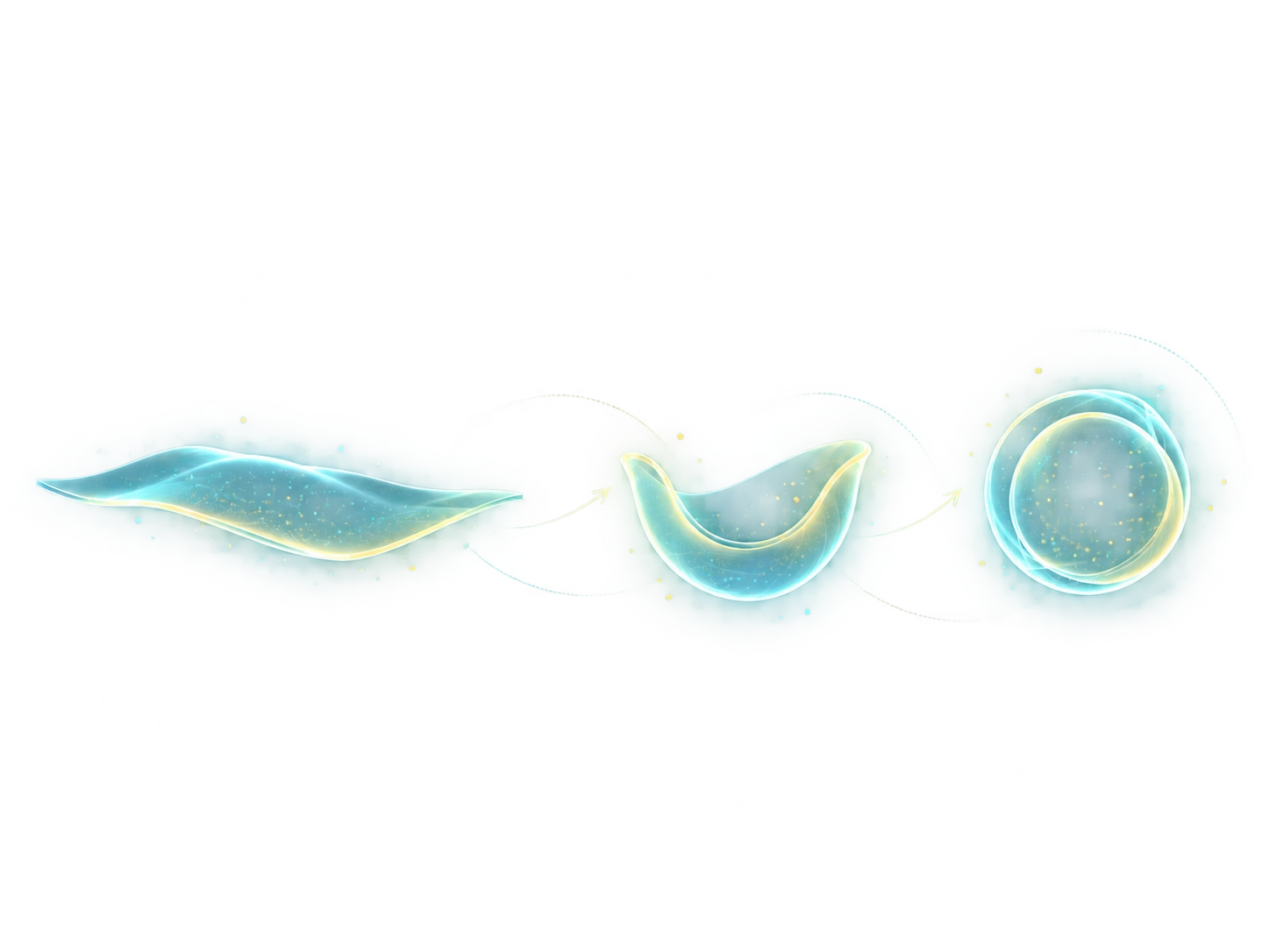
A membrane may be rounded like a sphere, curved like a bowl, or turned outward at its edge. The size of the membrane and its opening change how stable each shape is. By calculating these physical costs, we can explain changes in shape without assuming in advance what the final structure must look like.
Autophagy provides a clear example. A flattened membrane called a phagophore grows into a cup and eventually closes to form an autophagosome, which encloses material for recycling. We described these changes with a mathematical model in 2020 and compared the model with measured three-dimensional membrane shapes in 2024.
What we want to learn next
Published researchWe now want to learn how the types of lipids in a membrane and the proteins that bend it influence these changes. Their roles in switching between shapes remain questions to test.
Related publications & press releases
Three-dimensional measurements and physical modeling reveal characteristic shapes formed as autophagosomes grow.
A mathematical model explains how an open membrane can gradually change shape during autophagosome formation.